Have you not noticed that your couch is slowly becoming out of shape, in spite of the fact that it seems to be clean on top? Daily basis, upholstered furniture accumulates dust, body oils, spills, pet hair and allergens. The particles execute gradually in the bottom of the cloth and it cannot be washed by simply vacuuming it on a regular schedule. And in the case when you would like to get a cleaner that is more hygienic and avoids the harsh chemicals, a steam cleaner could turn into your new best friend.
The steam cleaning cleanses fabric in a way that does not remove easy to clean dirt or neutralise odour, even killing bacteria and dust mites. It is a proper way of restoring your upholstery and prolonging its life. This is the way it is possible to do it safely.
1. Test Upholstery Care Label
Before you start cleaning your furniture, it is always essential to examine the label on the packaging by the manufacturer of the furniture that you have. The upholstery will always possess expert cleaning regulations that define what kind of processes should be applied. The fabrics in the category of W can be washed using water based processes when compared to fabrics found in WS, which means that either water-based or solvent-based processes of washing are acceptable.
However, where the label reads S, it can only be cleaned with solvent and where the label reads X, it can only be cleaned with a vacuum cleaner. W and WS fabrics usually have the ability of steam cleaning, though not the unmoisture resistant ones. I will want to do a small experiment on a hidden and unnoticeable spot to make sure that the steam does not discolour or shrink.
2. Upholstery Cleaning through Vacuum Cleaning
The steam cleaning should not be applied to a dirty surface. Vacuuming removes the loose dirts, crumbs, pet hair and debris that would have otherwise been entrenched in the fabric during steaming. The upholstery should also be used with the vacuum cleaner; upholstery attachment should be used; this again should be done in close consideration to the seams and corners and crevices where the dust may be deposited. The same careful vacuuming approach is also essential when you clean indoor outdoor carpeting, as it helps lift embedded dirt before any deep cleaning process begins. Vacuuming well improves the work of the steam cleaner besides making sure that the outcome is improved as a whole.
3. Pre-Treat Stubborn Stains
To steam clean your upholstery, you should pre-treat your upholstery first with the visible stains on the fabric. Wipe a very weak upholstery conditioner or warm water and some detergent on the stained part. Gently blot the stain using a clean cloth instead of rubbing to prevent the further spread of the stain. Allow the solution to rest a bit in order to loosen up the stain. Pre-treatment will assist in shredding off hard spots, which will enable the steam to get in and pick out the rest of the residue.
4. Warm the Steam Cleaner
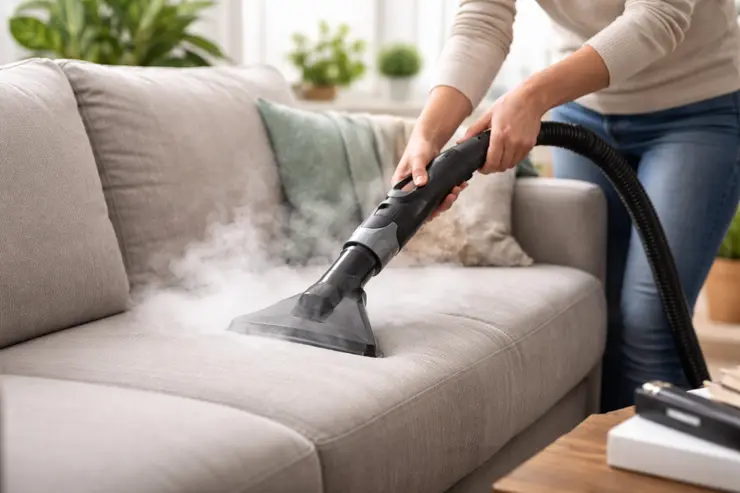
After preparing your furniture, prepare your steam cleaner by following the directions of the manufacturer. Add distilled water to the machine because it stops the accumulation of minerals in the machine and provides the same amount of steam all the time. It is important to leave the unit to heat before using. Most steam cleaners have upholstery attachments that are meant to spread steam uniformly, and the extra moisture does not get to the fabric in question.
It is always best to avoid adding chemicals unless it is explicitly stated in the appliance instructions, because usually the steam is the one that has all the power to sanitise and freshen upholstery.
5. Clean with Steam in Small Pieces
Work in small sections as opposed to trying to clean up the whole piece at the same time in order to have even work. Keep the steam nozzle a few inches above the fabric and also move it gradually and in overlapping movements. Do not stay too long in one locality as this may cause destruction of fibres by excess heat and moisture.
This is aimed at thoroughly dewaxing the fabric with steam, and not filling it. With high-utilising parts like armrests and seat cushions, you might require an additional pass, and you should always ensure that you have controlled and gentle movements.
6. Allow Proper Drying Time
It is very important that after steam cleaning, drying is done. They should also ventilate more by opening a window, switching on the fans or air conditioning to hasten the process of drying. Wet parts can be dried with clean and dry towel. Never sit on wet upholstery, it may result in new dirt being stuck on which can also cause odours or mildew. Drying can take some hours depending on the room conditions; patience is therefore important.
7. Learn The Advantages of Steam Cleaning
The benefits of steam cleaning are much deeper than surface cleaning. The steam has a high temperature to kill bacteria, reduce allergens and kill dust mites without leaving behind residues of the chemicals. It also eliminates the odours which are enclosed in the fabric and furniture smells fresh. Besides, steam cleaning consumes relatively small amounts of water as opposed to the conventional shampooing procedure; it is therefore an environmentally friendly professional cleaning process.
Conclusion
A steam cleaner is a good and useful method to clean the upholstery and refresh your furniture and make the interior cleaner. Through care label inspection, proper vacuuming, stain treatment, and cautious steaming, you are able to get a professional level of results in the home. Well-dried and well-maintained upholstered furniture will not only appear cleaner but also smell better and will last longer. Cleaning up your living room with steam will be why your money is well spent on having a beautiful sofa or chair that will immediately improve the comfort and look of the room.